Photo credit: Jérôme Habasque
Minimalist running in the era of carbon shoes: the story of a transition
Olivier Maria is the guy who runs in flip-flops. He has built a certain notoriety in the world of running and trail not only because he runs fast, well, and for a long time, but also because he does it either in sandals or barefoot. When you watch him string together kilometers with his toes in the open air and a smile from ear to ear, you might wonder if he isn’t a bit crazy.
The fact is, no quite the opposite.
His practice of minimalist running is the result of a thoughtful journey, of a philosophy that radiates through every aspect of his daily life, and of a strong commitment to his body and to the environment.
“I started running in 2015. At the time, I didn’t know much about it, so I went into a large multisport store to buy a pair of running shoes. I chose the most expensive pair in the shop, telling myself it had to be the best. They were big shoes, and it seemed to make sense. But since I’m someone who consumes information intensely, I started looking into it, and that’s when I came across Born to Run. In this book, Christopher McDougall tells how he goes to meet a tribe of Indians in Mexico who run barefoot. Even if the reality is much more nuanced than that, there is something a bit mystical in these stories of injuries disappearing from the moment you give up your shoes.
At the same time, I discovered the Clinique du Coureur, a source that still feeds me today. They recommend starting running with thin and lightweight shoes, because that’s how you build an efficient stride. So I had these two perspectives, one very inspiring and philosophical, and the other more technical and scientific, and I told myself I had to try.”
Olivier’s shift toward minimalist running is underway. Minimalism is a way of practicing sports, such as running or trail, with sensations close to barefoot, with a strong proximity to the ground.
“I started with mainstream shoes. At the time, it was quite easy to find light, flexible ones with thin soles. There were some that I liked so much that I wore them out completely. Little by little, I moved to specialized brands, and that’s when I discovered my famous sandals. That was 5 or 6 years ago, and I haven’t taken them off since.”
Minimalist running, or learning to run for yourself
Switching from maximalist shoes to zero drop does not happen overnight. Even for Olivier Maria, who got into it right after starting running, it took time. He is also very cautious: while he strongly states that nothing makes him happier than running barefoot or in sandals, he explains that it is a long and gradual process, one that should not be approached lightly. Minimalist running modifies the stride. Getting into it is demanding, especially for the calves, and can take several months.
Yet, this was not the most complicated part for Olivier Maria. He explains: “I was in an athletics club, and at that time, I had very thin shoes that looked like dance slippers. I didn’t really own them, so as soon as I was training or with other people, I would put my traditional shoes back on out of fear of comments. It took me years to dare to wear sandals, I was afraid people would think I was someone strange. We live in a society where we need to be accepted. Even today, I tell myself I might be the only one in sandals and I wonder how I will be looked at. If I get injured or if I run a bad time, there are always people who say it’s because I’m wearing sandals.”
It only takes a quick look at his Instagram account to understand where these fears come from: under a post where he talks about how he beat his personal best in a half marathon, you quickly come across comments suggesting that he could have run faster if he had been wearing shoes.
Fortunately, it takes more than that to discourage Olivier. Nothing is more enjoyable to him than covering kilometers barefoot or almost barefoot.
Performance, one stride at a time
Olivier Maria pays attention to the benefits of minimalist running on his body.
“Minimalism forces you to adopt a good stride. Traditional shoes, with a lot of cushioning, lead to a heavier stride that makes noise on the ground. Running barefoot, on an athletics track, in the grass or on sand, changes that, otherwise the shock wave on your heel travels all the way up to your teeth. By removing the cushioning from your shoes, you learn to develop a good stride for your body. It will naturally adopt a more protective posture, less noisy, lighter.”
But he always remains cautious:“People sometimes say that you get injured less with minimalist running. I don’t know if that’s true. What is certain, however, is that whatever the shoes, we often get hurt as soon as we try to do too much, too fast! I used to be the first to tell myself that I had to run 10 km every time, otherwise it didn’t count. Whereas in reality, every run, whatever its duration, is beneficial. Running, even if it’s just one or two kilometers, feels good. What matters is not doing more, it’s above all taking back control of your body and understanding how it works. Minimalism allowed me to reconnect with this primitive and natural side of running. When I beat my half marathon record, I had no stakes. I just told myself it could be fun to do it without shoes, and I was really happy to have run that fast.”

With an additional benefit, particularly for the health of his feet.
“I did a well-known Ultra-Trail in the Alps, and I am convinced that at the end of the race, I was the person with the feet in the best condition. First of all, I still had all my toenails. And my feet didn’t spend 30 hours soaking in damp socks. I had almost no blisters, and when I did, since my feet are always in the open air, they dry very quickly. The skin on my feet has toughened. It is thicker and stronger. Of course, after 40 hours running in the mountains, my feet were sore, but after a bit of rest and a few massages, it was much better. When you see the number of withdrawals in this type of race due to foot problems, it really makes you think.
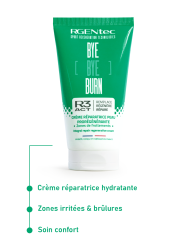
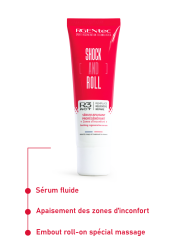
On the other hand, after 21 kilometers barefoot on asphalt, I had some pretty unpleasant blisters. I had trouble walking. I had already been usingShock & Roll for a few months to soothe pain in my calves and quads, because I love the massaging effect of the roll-on. But this time, I cleaned my feet, then massaged them with Bye Bye Burn, and it felt incredibly good.
So now, I use it all the time. Even as a preventive measure, especially on the glutes and thighs before doing ultra-cycling events, it’s almost like a little miracle, and I appreciate it even more because the brand aligns with my values, particularly in terms of eco-responsibility.”
Olivier Maria’s minimalist running, a maximal commitment
The way Olivier Maria runs says a lot about him, and about his personal commitments.
“I don’t have a car, I consume local whenever I can, I limit my waste. I live in a small apartment. I am involved in several environmental organizations. I didn’t immediately make the connection with my running practice. It was by talking with others that the fact of not flying, trying to have a minimalist lifestyle, and the sandals all of it is connected. I don’t compete on the other side of the world because, for me, we have everything we need in Europe, in France, to practice trail running. All of this is a minimalist philosophy. We go beyond equipment. I commit to somewhat extreme sports projects, in total autonomy, even for food supplies, without a car following me.
I can’t say too much for now, but I am preparing a great adventure of this kind… I can’t wait.”
A great opportunity to highlight this more natural vision of sport, respectful of people and the environment and without blisters, which we will follow closely!
To learn more about Olivier Maria, visit his Instagram account!